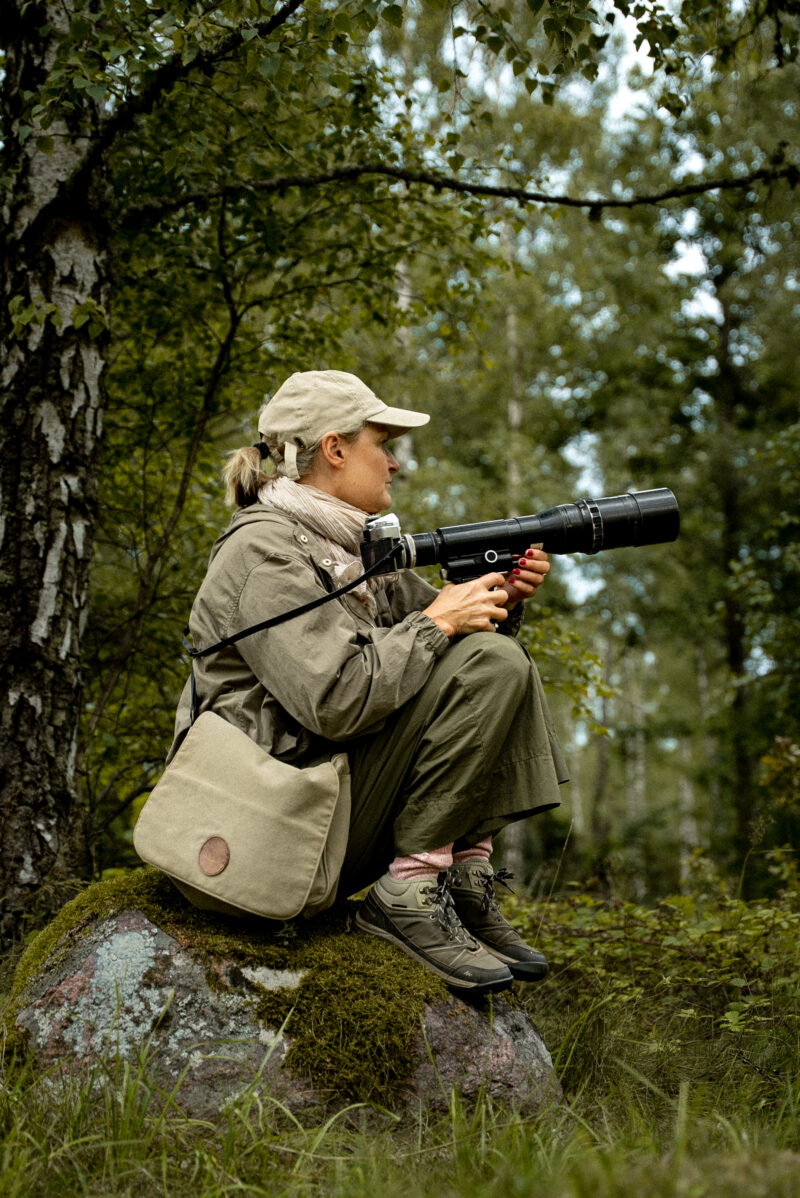
It’s with huge trepidation I pull out the first box from under my bed. Then the next one. And one more. And then a bag. And yet another bag.
All goes into the garage.
I’ve cleared a large space in the middle, pulled out a table and put a rug on the floor. Three micro fibre cloths, pen, paper and my laptop.
It’s time. I have to make decisions.

Like a three-dimensional encyclopaedia of camera equipment from the late 1950’s to current times, everything is spread out in front of me. From the green Arco Eight 8mm Cine camera from 1959, to the last Sony Alpha he bought. The 400mm Novoflex that looks like a machine gun. The smallest Canon Demi half-frame from the 1960’s, which he gave to my mum.
Packed in the bags and boxes is the history of cameras, but also the history of my dad’s big passion – photography. A passion we had in common; a passion he gave me, taught me and supported all his life.
Never a professional, never interested in making money from his photos, but always with a camera in close proximity – that was my dad.
He got his first camera himself from an uncle and quickly grew both more interested and skilled. Traces of his darkroom practice could be found wherever he spent time, and of course a huge number of negatives, proofs, contact sheets and printed photos.


My dad was mainly into wildlife photography and people. Bit like me, but I’ve taken my photography to a professional level, and I now do brand photography for a living.
Although I have around 25 external hard drives full of photos and video, I have relatively few prints left. My dad left masses and masses of photos of unknown students, teachers, hunters, local fishermen, neighbours and foreigners from all the countries he travelled through, piled up in boxes and bags. And of course deer, lions, elephants and all other animals, both local and exotic.
And so also the equipment that was required. Long lenses, short lenses, macros. From the early Minolta T1 35mm cameras to the latest Dynax.
I grew up on Minolta for this reason – my dad had all the gear. Although my very first camera was a tiny little Robot Star, a German half-frame camera that I loved from when I was 12 years old. This camera lay the grounds for my knowledge of exposure, focus and composition – the three fundamental components of photography that I now teach myself.
Minolta was a major Japanese camera brand that seized production in 2006 due to the increased digital competition – they transferred all camera operations to Sony, which built its successful Alpha DSLR line from Minolta’s technology.

When I started photography school in Stockholm at the age of 20, both my teachers used Nikon. It gave me the impression that “real” photographers use Nikon.
I loved the photography sessions. Most of all I loved composition, and I also loved analysing the photos after as a group. Not overly keen on 35mm film development and the darkroom printing process. Hours in the dark, slow progress, tedious meticulous calculations before you finally had a result. Thank god for Photoshop!
Photography became part of my job as I went into casting for film and TV after film school. We needed portraits of all actors, and I also worked in production and loved doing the behind-the-scenes shots. But that petrifying wait before you saw the result of your work made me decide never to become a photographer. I imagined the wedding kiss that you don’t see the print of until three days later, only to find that it’s blurry or wrongly exposed… no thanks!
After photography school, I went full in to film production instead. I worked as a freelance casting director and production manager for huge commercials shot in Stockholm, LA and all over the world. I moved between New York and Stockholm and eventually settled down in London.
So it took another ten years before I decided to take on a photography job by a large marketing agency in London that required me to use a digital camera. I was heavily against it at first. But I was pregnant and the fast paced advertising world has burnt me out. I needed a change.
Ridiculous I thought – digital photography will never catch on. Anyone can see it’s a “fake” image. No depth, lousy blacks, no feeling and just plain amateur business.
But I got the camera…
I decided to stay with what at that time had become Konika Minolta, and I got the cost of my new digital camera back from the job. And suddenly I could see the scope of it. This was huge. This would change the future of photography. This could change my life.


I started taking on more work. A local holiday let company needed constant property photos for their online site, and they asked if I could help them. I enjoyed the shorter shoots – instantly seeing the image, being able to snap a few extra shots for safety without running out of film – and deliver them almost instantly.
More work followed on. Like so many other new photographers, I took on everything that came my way. Family portraits, karate clubs, swim schools, drama shows, even school photography. I did sports and dogs, food and weddings. I did more property, more portraits, more interior design and more conferences. Then I started doing more corporate travel photography. Which led me to stop everything else. I decided that I didn’t want to have anything to do with kids, dogs, weddings, property or food. So I was left with portraits and something quite new that took off like a wildfire – social media and brand photography.
Alongside this, I developed my photography art and design. Instagram opened up a whole new world for sharing daily inspiration and more creative shots. And on top of this golden opportunity to be creative, it was based around the square crop – just like the old Instamatic it borrowed its name from – I loved it (safe to say I was left stunned when they decided to change the crop to 4:5 only a few months ago. Like – what??).
Back in 2008, I discovered Photoshop, and realised that I had to master this, both as a work tool and as an artform. So I applied for a course at Brighton university, and for five weeks I happily left my toddler and his dad and wandered off to the best Mi-time I could have. I was in heaven.
And then suddenly I was there. I was able to afford a “proper camera”. I bought my first Nikon, a D700 – and I finally felt like a professional photographer. And I fell instantly in love. It was like I had a new partner, a workhorse and an extension to my brain with a huge capacity and never faltering engine. I loved it to a point where my son started tucking it into his buggy, saying “Mum, you love your camera more than me.” And “You would throw me off the pier before your camera”.
Absolutely not true of course and his cheeky grin showed that he was just fishing for love affirmations!

As my son grew up, he followed the long line of craftsmen in the family and picked up the camera too. But now it was all about video. And as I started my company The Vlog Academy, I took the drastic decision to support both video and still photography on the same system – and jumped ship from Nikon to Sony. The main reason was the video focus. It was way behind on Nikon back then, even though I still consider Nikon having a much more beautiful feel. So new lenses, new filters, new flashguns, new everything. And my latest Nikon D800 was left redundant in my cupboard… And the circle was closed, although the name has long changed from Minolta to Sony.
So back to the garage, many moons after that first little Robot Star. And I now see my whole childhood in front of me, including my dad’s journey from start to finish. There have been even more cameras – they spread out among the kids and grandchildren to kindle their interest but have all ended up in shoeboxes or on dusty shelves.
I need three days to ponder upon this emotional decision. Three days of just letting it sink in, through my body and up through my brains again.
I ask my son’s advice. “Keep it all” he says. What if Minolta becomes a collectable item in a few years!
Well, what if it doesn’t. And film is back on trend, so it would be now – if ever.
We’ve already had to get rid of thousands and thousands of photo prints and slides, old high quality development equipment and darkroom paraphernalia, even liquids left in the bottles and jars.
As we cleared out our huge attic, we realised that both sides of the family had keen photography interests, my grandfather was a graphic designer and a photographer, his father a graphic designer too with a keen interest in photography – we found yet another three boxes of prints from my great grandmother’s side. I can assure you that the process of handling this number of photos is hard and very time consuming.
So today I’ve pulled aside just a couple of the original cameras and the Arco 8mm film camera, a couple of lenses and a bag. This, plus my own old 35mm cameras, an old medium format Yashica, an Instamatic, a newer Nikon 35mm I bought recently and my entire digital pack, will carry on for a little longer in the family and be left for the next generation to deal with. I wish them great fun with that!